If your home was built or replumbed between the 1970s and early 2000s, there's a reasonable chance your supply lines are CPVC pipe. Tens of millions of homes still rely on it, and most homeowners have no idea it's there until something goes wrong. CPVC ages in ways that aren't visible from the outside, and when it fails it tends to do so inside walls and under floors where water damage builds quietly for weeks.
Quick Answer: CPVC pipe is a rigid thermoplastic used for hot and cold water supply lines in residential plumbing. It's rated for temperatures up to 200 degrees Fahrenheit and pressures up to 100 PSI, making it suitable for both hot water and standard residential supply pressure. Over time, CPVC becomes brittle, particularly when exposed to chlorine in municipal water supplies, certain cleaning chemicals or physical stress at fittings. A licensed plumber can assess CPVC condition and advise on repair or replacement.
What Makes CPVC Pipe Different From Standard PVC
Standard PVC is not rated for hot water and is used for drain lines. CPVC contains additional chlorine in its molecular structure, which raises its heat tolerance and made it the supply line material of choice before PEX became widely adopted in the 2000s.
CPVC is joined with solvent cement that partially dissolves both surfaces and fuses them when cured. An incorrectly made joint, with insufficient cement or poor pipe preparation, is a weak point that can fail under pressure years later. The ASPE identifies improper solvent cement technique as a leading cause of CPVC joint failure in residential systems.
6 Critical Facts About CPVC Pipe That Every Homeowner Should Know
CPVC becomes brittle over time, especially in chlorinated water systems.
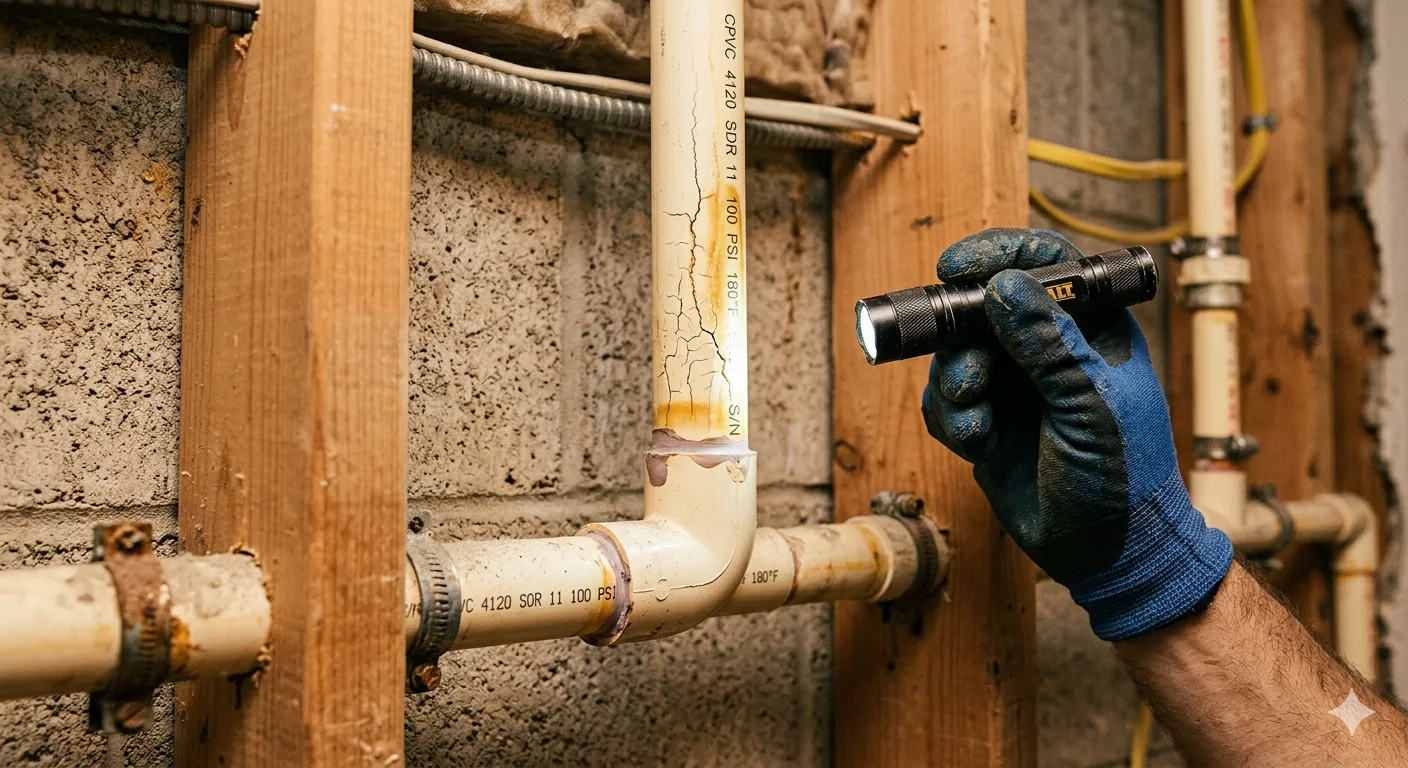
Chlorine in municipal water causes a reaction in CPVC that weakens its molecular structure over 20 to 30 years. A correctly installed pipe from 1990 may be near the end of its reliable service life today. Brittleness shows up first at fittings and elbows, where stress concentrates. The pipe looks fine from the outside right up until it cracks.
Certain household chemicals destroy CPVC on contact.
Spray lubricants containing petroleum distillates, insect sprays, solvent-based cleaners and certain plasticisers can penetrate and degrade CPVC quickly. The EPA notes that exposure to incompatible substances is a primary cause of premature pipe failure. If a spray product has been used near CPVC pipe in a utility room or crawl space, those sections deserve inspection.
CPVC pipe cannot be bent and requires proper support.
CPVC is rigid and must be cut and fitted around every obstacle with elbows and couplings. It expands and contracts with temperature changes. Long unsupported runs sag over time, creating stress at joints. Pipe clips should be placed every 3 feet for horizontal runs and every 6 feet for vertical runs. Unsupported CPVC is one of the most common causes of joint stress failure in older systems.
A CPVC joint that fails inside a wall can cause serious damage before it's detected.
This is the most consequential fact about CPVC pipe failure. The pipe runs behind drywall, under subfloors and through ceiling cavities. A joint that develops a slow leak at a fitting drips into the wall cavity, saturating insulation and structural framing. The CDC identifies hidden moisture in wall cavities as a primary condition for mold growth, which can become a health hazard within 24 to 48 hours of a wet surface forming. By the time discolouration appears on the wall or ceiling, the damage inside is already extensive.
CPVC and copper cannot be joined directly.
Joining CPVC directly to copper requires a dielectric fitting that compensates for the different thermal expansion rates. A direct metal-to-plastic joint creates a stress point that works loose over time. If your home has a mixed CPVC and copper supply system, every transition point is worth having a licensed plumber inspect.
Homes with CPVC pipe installed before the mid-1990s are at elevated risk.
Manufacturing standards for CPVC improved significantly through the 1990s. Pipe produced before those improvements was more prone to chlorine degradation and brittleness at lower ages than later production. Homes where the original CPVC installation dates to the 1970s or 1980s are approaching or past the point where a proactive assessment by a licensed plumber makes sense. The cost of identifying and replacing a failing section is a fraction of the remediation cost for a wall flood event.
When CPVC Pipe Needs to Be Replaced Rather Than Repaired
A single cracked section can be cut out and replaced. When a CPVC system shows brittleness or cracking at multiple points, patching individual sections is not a long-term solution. The underlying cause affects the entire system, not just the visible failure points.
A licensed plumber can advise whether targeted repairs are appropriate or whether full repiping with PEX or copper is more cost-effective over the next five to ten years. Whole-home repiping costs between $4,000 and $15,000 depending on home size and material. That is large, but significantly less than water damage remediation, mold treatment and structural repair that a failing CPVC system can generate.
Frequently Asked Questions About CPVC Pipe
How do I know if my home has CPVC pipe?
CPVC is cream or light yellow in colour, rigid and typically found running from the water heater and along supply lines inside walls and under floors. It is marked with "CPVC" and a temperature and pressure rating on the pipe body. Standard PVC, which is white and used for drains, is not the same material. A licensed plumber can confirm what type of supply pipe your home has during a routine inspection.
Can CPVC pipe be repaired without replacing the whole system?
Yes. A cracked section or failed joint can be cut out and replaced without disturbing the rest of the system. If inspection shows the rest of the pipe is sound, targeted repairs are reasonable. Widespread brittleness at multiple points warrants considering full replacement.
Is CPVC pipe safe for drinking water?
Yes. CPVC is approved for potable water use and meets NSF/ANSI Standard 61 for drinking water system components. The material does not leach chemicals into water under normal operating conditions. Concerns about CPVC relate to mechanical failure and longevity, not water quality.
How long does CPVC pipe last?
CPVC has a typical service life of 50 to 75 years under ideal conditions. In practice, chlorine exposure, incompatible chemicals or improper installation can reduce that significantly. Systems installed in the 1970s and 1980s are approaching the range where a professional assessment makes sense regardless of whether visible problems have appeared.
Find a Trusted Local Plumber to Assess Your CPVC Pipe Today
CPVC pipe that was correctly installed and is in good condition can last for decades more. CPVC that has been exposed to incompatible chemicals, installed with incorrect technique or aged past its reliable service window is a water damage event waiting to happen. The only way to know which situation you're in is to have a licensed plumber assess the system.
Visit PlumberLocator.us to find a licensed local plumber in your area who can inspect your CPVC pipe and advise on repair or replacement. For more guidance on home plumbing systems, browse our plumbing tips section.