Your plumber says you need an expansion tank before they'll install the water heater. You've never heard of one and you're wondering whether this is a real requirement or an upsell. Water heater expansion tank installation is a genuine code requirement in most US jurisdictions and skipping it creates pressure problems that damage your plumbing system silently over time.
Quick Answer: A water heater expansion tank absorbs the increased water volume created when cold water is heated in a closed plumbing system. Without it, thermal expansion pushes that extra pressure back through the system, stressing valves, fittings and the water heater itself. Installation is required by code in most jurisdictions with closed-loop or backflow prevention systems. A licensed plumber sizes, installs and pressure-sets the expansion tank correctly as part of a water heater installation.
What Thermal Expansion Is and Why It Matters
When cold water is heated to 120 degrees Fahrenheit it expands by approximately 2%. In a 50-gallon water heater that creates roughly one additional gallon of water volume per heating cycle. That extra volume has to go somewhere.
In older open systems, excess pressure pushed back toward the street connection. In closed systems, which include any home with a PRV, backflow preventer or check valve on the main supply, that path is blocked. The expansion has nowhere to go except back into the system. The EPA identifies uncontrolled thermal expansion as a significant cause of premature failure in relief valves, supply line fittings and fixture connections.
6 Critical Facts About Water Heater Expansion Tank Installation
Your system is almost certainly a closed system.
Most homes built or replumbed in the last 20 years have a PRV on the main supply line. A PRV creates a closed system by blocking return flow. Most municipalities have also required backflow preventers for decades. Either device closes the system and makes water heater expansion tank installation a code requirement. If your home has a PRV, which a licensed plumber can confirm in seconds, you need an expansion tank.
The T&P valve is not a substitute for an expansion tank.
Many homeowners assume the T&P valve handles thermal expansion. It does not. The T&P valve opens only when the heater reaches dangerously high temperature or pressure. Repeatedly cycling it through thermal expansion causes it to wear, drip and fail to reseat when genuinely needed. The PHCC notes that T&P failure from thermal expansion cycling is one of the most preventable safety failures in residential plumbing.
Expansion tank sizing is not one-size-fits-all.
The tank must be sized based on three variables: the water heater storage capacity, the supply pressure and the bladder pre-charge setting. A tank sized for 40 PSI will underperform at 70 PSI supply pressure. A licensed plumber measures supply pressure with a gauge before selecting the correct size for any water heater expansion tank installation.
The expansion tank must be pre-charged to match supply pressure.
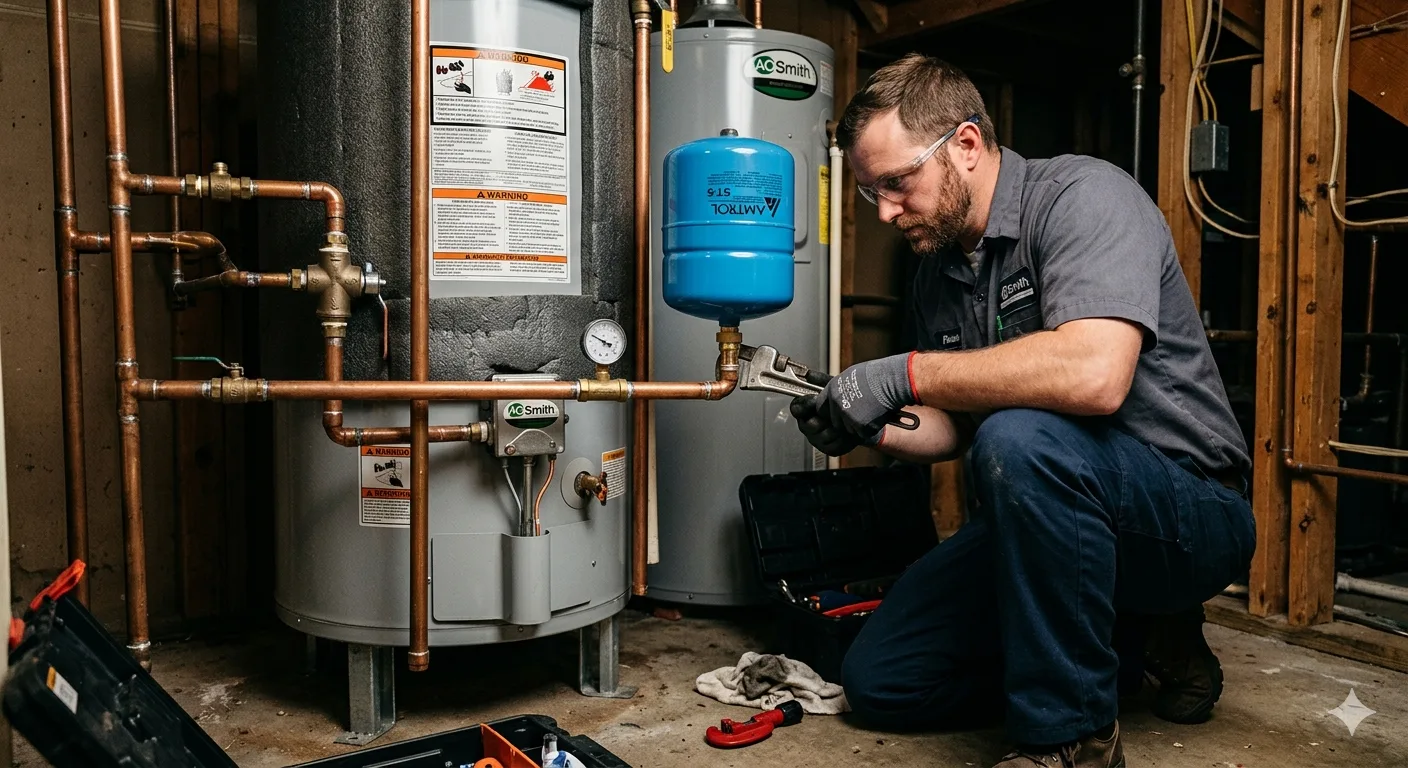
An expansion tank contains an air bladder separated from the water chamber by a rubber diaphragm. The air side must be pre-charged to match the static supply pressure of the system before installation. If it is installed at factory pre-charge of 40 PSI in a home with 75 PSI supply pressure, the bladder is immediately compressed to its minimum volume and provides no useful buffer at all. Checking and adjusting the pre-charge with a tyre pressure gauge before installation is a step that is frequently skipped on DIY expansion tank installations and produces a tank that offers no protection.
Installation location affects performance and access.
The expansion tank must be installed on the cold water supply line entering the water heater, not on the hot side. It is typically mounted on the cold water inlet at or near the top of the tank, either vertically or horizontally depending on the available space. A horizontally mounted tank must be adequately supported to prevent stress on the connection over time. The CDC notes that improperly supported plumbing connections are a leading cause of gradual fitting failure in residential water systems. The tank should also be installed in a location that allows the bladder condition to be checked periodically and the tank replaced when the bladder eventually fails.
Most water heater warranties now require an expansion tank.
Major water heater manufacturers including Rheem, Bradford White and AO Smith have updated their warranty terms to require expansion tank installation in closed systems. A water heater installed without an expansion tank in a closed system is operating outside its warranty conditions. When the T&P valve fails from thermal expansion cycling or the tank develops an internal crack from sustained over-pressure, the manufacturer has grounds to deny the warranty claim. Water heater expansion tank installation is not optional when the manufacturer requires it and when local code mandates it.
What a Correct Water Heater Expansion Tank Installation Includes
A complete water heater expansion tank installation involves measuring static supply pressure, selecting the correctly sized tank, pre-charging the bladder to match supply pressure and installing on the cold supply line with adequate support. The installation should be pressure-tested to confirm the tank is absorbing the thermal expansion cycle correctly. A tank installed without testing may be pre-charged incorrectly or connected with an inadequate fitting.
Frequently Asked Questions About Water Heater Expansion Tank Installation
How much does expansion tank installation cost?
A standard residential expansion tank and professional installation runs $150 to $350 depending on the tank size required and the complexity of the connection point. This is almost always performed at the same time as a water heater replacement to avoid a separate call-out charge.
How long does an expansion tank last?
Most residential expansion tanks last 5 to 10 years. The rubber bladder hardens and loses flexibility first. When it fails the tank fills with water and provides no buffer; a waterlogged tank feels solid when tapped. Replacing it is a straightforward job for a licensed plumber.
Can I install a water heater expansion tank myself?
The physical installation is within reach of a confident DIYer. The critical step that is frequently missed is pre-charging the air bladder to match the actual static supply pressure before installation, which requires measuring supply pressure with a gauge and adjusting the bladder with a pump. An incorrectly pre-charged tank provides no benefit. Having a licensed plumber install and verify the complete system is the reliable path.
How do I know if my expansion tank has failed?
Press the Schrader valve on the air side of the expansion tank. If water comes out instead of air, the bladder has ruptured and the tank is waterlogged. If the T&P valve on the water heater is dripping repeatedly, it may be responding to thermal expansion pressure that the tank is no longer absorbing. Either sign warrants immediate expansion tank replacement.
Find a Trusted Local Plumber for Expansion Tank Installation Today
Water heater expansion tank installation is a straightforward job when it's done correctly the first time. Getting the sizing, pre-charge and connection right protects your water heater warranty and your system from years of silent pressure damage.
Visit https://plumberlocator.us/emergency/ to find a licensed local plumber who can size and install the correct expansion tank for your system. For cost estimates on water heater services, browse our https://plumberlocator.us/cost-guide/.